

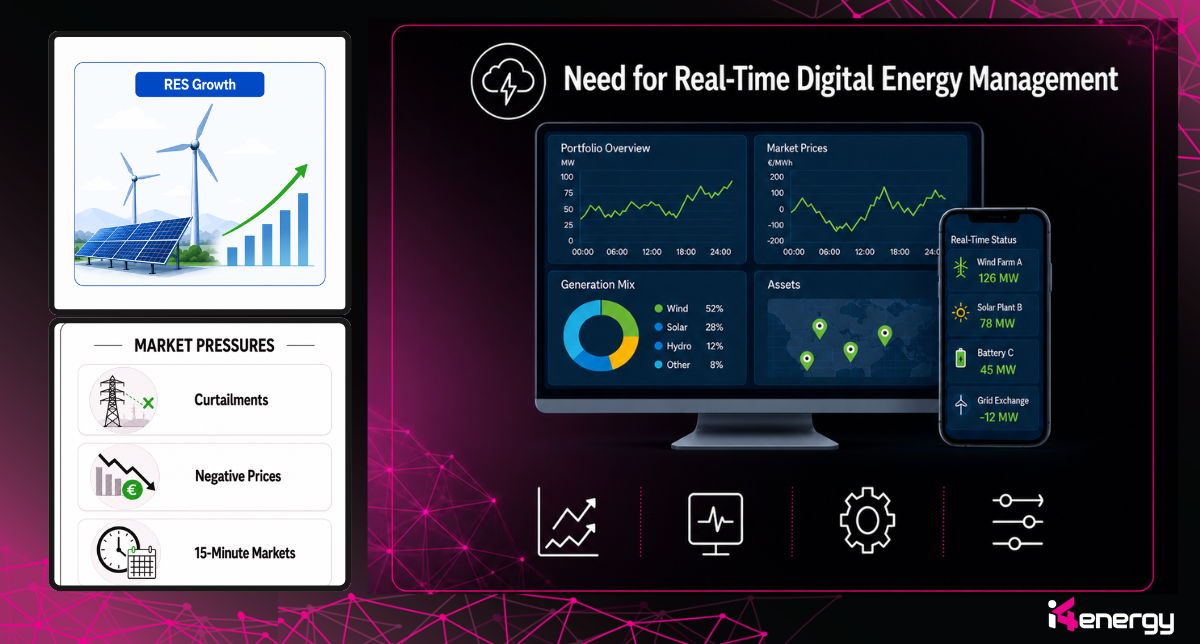
The energy transition is entering a new and more demanding phase.
For years, the main objective across Europe was clear: accelerate renewable energy deployment. Today, the challenge has evolved. As RES penetration grows, energy systems are becoming more decentralised, more volatile and more complex to operate.
The question is no longer only how much renewable capacity can be installed, but rather how effectively this capacity can be monitored, forecasted, controlled and optimised in real time.
Recent market data makes this shift clear. According to Reuters, Europe’s solar power capacity has increased by more than 115% since 2020, doubling the amount of solar electricity flowing through regional grids. At the same time, high solar production during midday periods is increasingly creating system stress, negative prices and curtailments.
The impact is already visible in Greece. Recent market reporting shows that photovoltaic parks under support schemes / CfDs lost an average of 50% of revenues year-on-year in April, while some companies reported losses of up to 60%, due to zero or negative prices and production curtailments.
This is not a temporary market anomaly. It is a structural sign of a power system under transformation.
From Capacity Growth to Operational Complexity
The rapid growth of RES is changing the way energy assets must be managed.
Solar parks, wind farms, batteries, hybrid stations, prosumers, energy communities, flexible loads and EV charging infrastructure are no longer passive assets. They are active parts of a dynamic energy system that needs continuous coordination.
At a European level, co-located renewable and battery capacity is expected to grow from 6.3 GW in 2025 to around 35 GW by 2030 (+450%). At the same time, renewable curtailments across Europe are forecast to rise from over 10 TWh in 2024 to around 33 TWh by 2030.
These numbers highlight a clear market direction: flexibility, storage, forecasting and real-time control are becoming essential.
The 15-Minute Market Raises the Bar
The shift of the EU day-ahead electricity market from hourly to 15-minute trading intervals further increases the need for precision.
Day-ahead prices are now calculated every 15 minutes, reflecting generation and demand conditions with greater granularity. This creates a more responsive market, but also a more demanding one.
For Power Producers and Aggregators, this means that forecasting, nominations, dispatching, imbalance management and portfolio optimisation must happen faster and with greater accuracy.
For Large Consumers, Prosumers and Energy Communities, it creates new opportunities to use flexibility strategically.
For Grid Operators, it reinforces the need for reliable telemetry, remote control and active coordination of distributed energy assets.
Software Becomes the Critical Layer
In this new environment, digital energy management is becoming the critical layer between assets, markets and grid stability.
Real-time software enables energy stakeholders to move from passive monitoring to active orchestration. It allows operators to forecast production and demand, detect deviations, respond to market signals, activate flexibility and optimise performance across technical and commercial parameters.
This is especially important in a market where profitability depends not only on the volume of energy produced, but also on timing, responsiveness and operational accuracy.
i4energy’s Role
At i4energy, this is exactly the challenge across® platform was developed to address.
across® is a purpose-built digital energy ecosystem for real-time monitoring, control and optimisation of energy infrastructures.
It supports operations across generation, portfolio management, storage, demand, microgrids, EV charging infrastructure and market interaction.
Through modules such as Generation Management, Energy Management, Demand Management and Market Management, across® platform provides a unified environment for forecasting, dispatching, real-time monitoring, remote control, energy optimisation and deviation management.
Its open architecture enables integration with existing assets, IIoT technologies and third-party systems, while supporting both cloud and on-premise deployment models.
This is critical for energy players that require scalability, cybersecurity, data ownership and long-term investment protection.
i4energy’s field-proven experience demonstrates this capability in practice. Indicative recent projects include deployments of Demand-Response Management Systems, Integrated Monitoring and Remote-Control Systems for RES, thermal and hybrid power production portfolios.
Today’s Operational Advantage
The energy transition is creating major opportunities, but also new operational risks which require a new level of digital intelligence.
Real-time energy management is today’s operational advantage, helping energy stakeholders to reduce exposure to curtailments and imbalances, improve operational visibility, support better decision-making and unlock the value of flexible assets.
As energy systems become more decentralised, dynamic and market-driven, software becomes the foundation for reliable, efficient and profitable energy operations. Real-time energy management provides the competitive edge in today’s volatile energy sector.