

As renewable capacity expands and grid constraints intensify, real-time control, interoperability and energy orchestration are becoming essential to efficient energy system operations.
Across Southeast Europe, recent developments point to a fundamental shift in the energy transition. Building new renewable generation capacity remains essential, but the ability to connect, control and coordinate energy assets is becoming equally important.
From Romania’s introduction of competitive grid capacity allocation to Albania’s first major wind power project and Europe’s progress toward vendor-independent SCADA/EMS architectures, the direction is increasingly clear: the energy transition requires more than infrastructure expansion. It requires smarter, more flexible and better-coordinated energy operations.
Grid Capacity Is Becoming a Strategic Resource
Romania’s introduction of competitive grid connection capacity auctions, beginning on October 30, 2026, marks an important development in how new generation and storage projects access electricity infrastructure.
Under the new framework, eligible projects of at least 5 MW compete for available connection capacity, moving away from traditional first-come, first-served allocation. Initial published data indicated no available auction capacity for the years 2028–2031, highlighting the constraints facing new energy investments.
The implications extend beyond connection procedures.
As grid access becomes more constrained and economically significant, project developers and operators face growing pressure to demonstrate that their installations can operate reliably within network limitations.
This brings greater attention to capabilities such as real-time monitoring, generation forecasting, dynamic export limitation, remote dispatch and coordinated storage operation.
Digital control cannot replace physical grid capacity or guarantee a connection. However, it can enable assets to operate within technical constraints, respond accurately to grid operator instructions and manage available capacity more effectively.
The value of an energy asset increasingly depends not only on its installed capacity, but also on how effectively that capacity can be controlled and optimized.
Renewable Expansion Creates New Coordination Requirements
Albania’s recently announced construction agreement for the 72.6 MW Spille wind farm, with operations expected in 2028, represents an important step in diversifying the country’s renewable energy portfolio.
Beyond expanding clean electricity production, the integration of additional variable generation introduces new operational requirements.
Wind and solar production depend on changing weather conditions. Their increasing contribution to the energy mix requires more sophisticated forecasting, real-time visibility and the ability to adjust production according to network conditions.
At the same time, the growing deployment of battery energy storage systems (BESS) creates additional opportunities for flexibility, while introducing further operational complexity.
Generation and storage assets must increasingly be managed as interconnected components rather than isolated installations.
Effective energy management therefore requires the ability to coordinate production forecasts, storage availability, consumption patterns, grid constraints and market commitments within a unified operational environment.
As a result, digital energy management is evolving beyond monitoring individual assets toward the orchestration of entire energy portfolios and across energy value chain.
Open Architectures Are Reshaping Digital Grid Management
A parallel transformation is taking place in the technologies used to monitor and control electricity networks.
In October 2026, the European InterSCADA project reported progress in connecting its open-source, vendor-independent SCADA/EMS platform to operational environments across Greece, Italy, Spain and France.
The project is particularly significant because its architecture allows new digital functionalities to operate alongside existing control systems, using common data models and communication mechanisms.
Meanwhile, Romania’s approved 2026–2035 transmission network development plan includes 117 investment interventions, covering infrastructure modernization, digitalization and advanced monitoring and control technologies.
Together, these developments reflect an important technology direction: electricity infrastructure increasingly requires systems that can exchange information and coordinate operations across different technologies, manufacturers and operational environments.
Interoperability, modular architecture and flexible integration are therefore becoming essential foundations for future energy management.
Yet interoperability alone is not sufficient. The real value emerges when integrated data can support reliable operational decisions, automated responses and coordinated control.
From Asset Control to Energy Orchestration
These developments highlight the increasing importance of a more advanced operational layer.
Traditional monitoring provides visibility into asset performance. Control systems enable operators to adjust individual installations. Energy orchestration extends these capabilities by coordinating multiple assets, operational requirements and market objectives.
At this level, generation, storage and flexible demand are no longer managed independently.
Instead, real-time measurements, forecasts, operational constraints and market information can be combined to support coordinated decisions across the energy system.
For energy producers, this means better management of generation schedules, export limitations and operational performance.
For aggregators and portfolio operators, it enables the coordination of distributed assets, storage flexibility and market commitments, including imbalance management.
For grid operators and energy system stakeholders, greater visibility and responsiveness across connected resources can support more effective network management and the integration of additional renewable capacity.
The objective is to move beyond fragmented control toward unified, real-time management of increasingly complex energy operations.
Enabling the Next Phase of Digital Energy Management
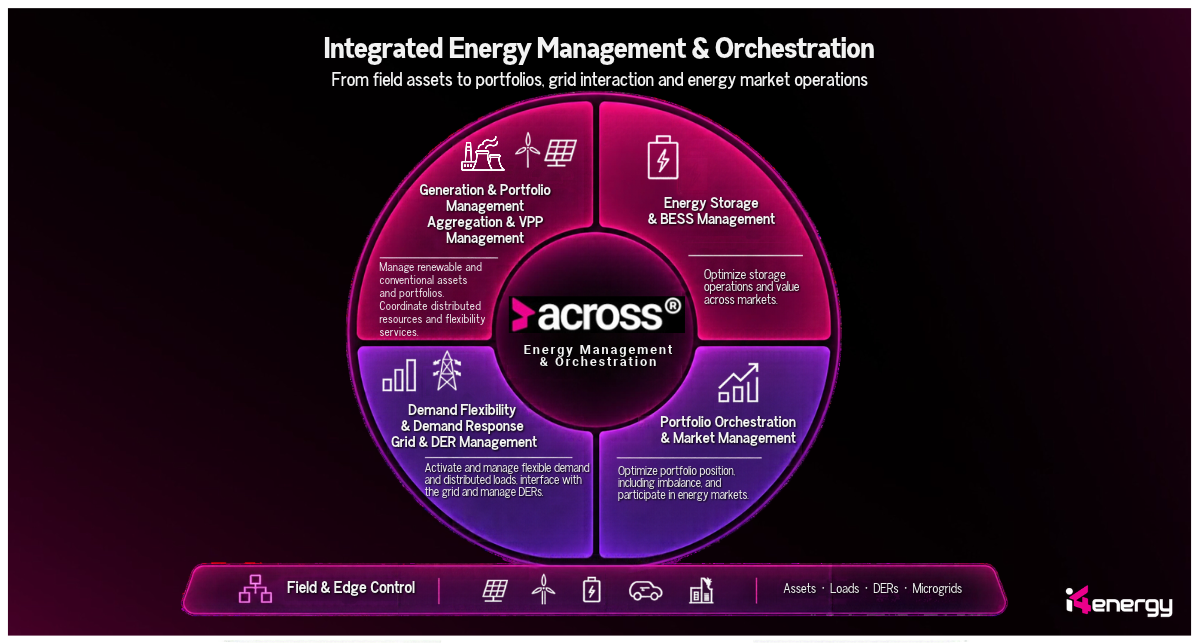
At i4energy, this approach is reflected in across®, the company’s purpose-built digital energy management and orchestration platform.
Designed to support distributed energy resources and complex energy operations, across® integrates real-time monitoring, control, forecasting, optimization and orchestration across generation, storage, demand and energy market activities.
Its modular, interoperable architecture allows seamless integration of different technologies and operational systems, supporting energy management from individual assets to complex portfolios and providing a unified digital environment that adapts to each project’s infrastructure, complexity and objectives.
As Southeast Europe’s energy infrastructure continues to evolve, the challenge will not simply be to add more generation, storage or grid capacity.
It will be to make these resources work together – reliably, efficiently and intelligently.
Real-time digital energy orchestration becomes a critical enabler of energy transition. This is the value of across®: transforming fragmented energy operations into an integrated, intelligently orchestrated energy ecosystem, tailored to the needs of each project.